
Addressing Housing Needs with Incentives for Smaller, More Affordable Homes
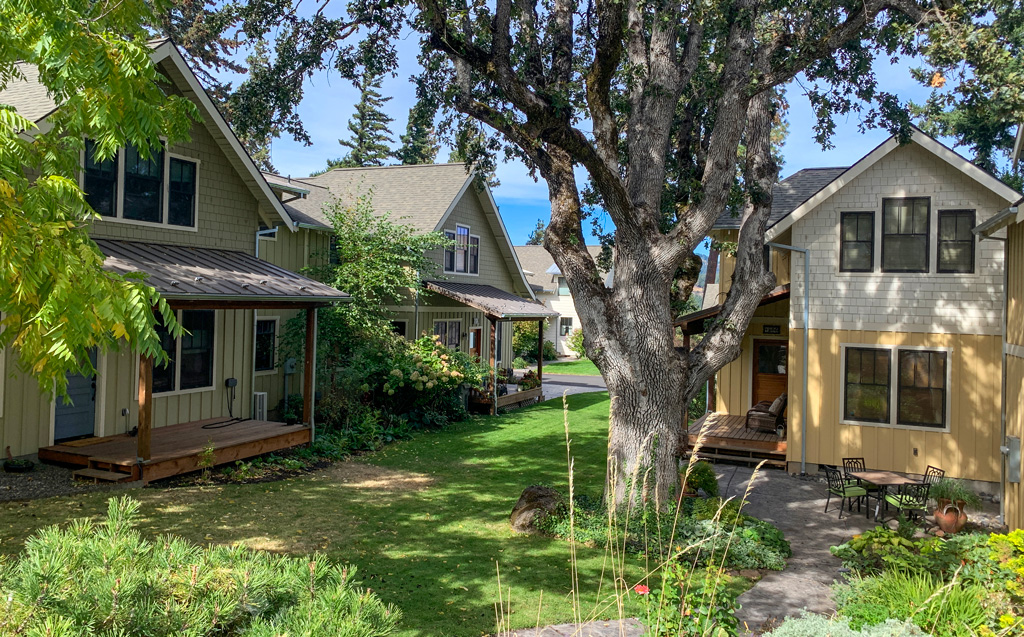
Improving housing affordability is a top policy priority for the City of Hood River. Some major accomplishments in this effort include securing funding for a 130-unit Affordable Housing Complex that will break ground in 2025, adopting a “Middle Housing Code” to promote the creation of more space efficient housing types, and regulating short-term rentals in residential neighborhoods. The City recently announced two additional housing programs: a Small Home Construction Incentive in the Westside Urban Renewal District; and, a Space-Efficient, Affordable, and Workforce Housing Grant program.
Small Home Construction Incentive in the Westside Urban Renewal District
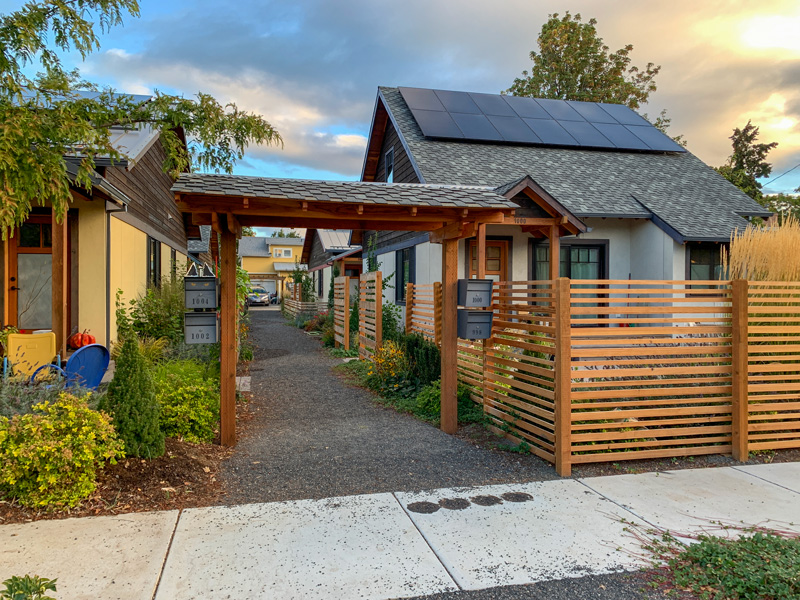
Builders of smaller homes face a disadvantage when paying development fees. This is because state law requires that development fees be based on a new home’s actual impact on parks, water, sewer, and other public infrastructure, without regard to the new home’s sales price. This can result in a small cottage cluster paying 14% of its construction cost in development fees, while a large single-family home typically pays around 7%.
To address this issue, the Hood River Urban Renewal Agency has approved a new construction incentive to reimburse builders of smaller homes for development fees paid in excess of 7% of a home’s construction cost. The goal of this incentive is to remove an unintended barrier to the creation of smaller homes that are often more attainable for first-time home buyers. To be eligible, new homes must:
- Adhere to the City’s Middle Housing code or comply with specific size restrictions for apartments. The Middle Housing Code (cityofhoodriver.gov/2021spring-middle-housing-code/) passed in April of 2021, allows for the construction of smaller houses (including cottage home clusters, existing home conversions, duplexes, and triplexes ) to be built compatibly in established neighborhoods. The code enables the builders to better use the limited land inventory to create homes. While a number of middle housing units have been built since the implementation of the Middle Housing Code, builders still encounter challenges, largely due to the high costs associated with land and development.
- Build within the Westside Urban Renewal District, which contains most of the City’s undeveloped land. The Westside District (cityofhoodriver.gov/urban-renewal/westside/) was created in part to fund programs in the 2022 Affordable Housing Strategy (cityofhoodriver.gov/wp-content/uploads/2022/05/HR-AHS_final%C2%AD_5-5-2022.pdf).
The construction incentive will be paid to small home builders when their project is completed and put on the tax rolls. The incentive is funded with the additional tax revenue generated from each new home.
The incentive program was recently approved for financing by the Oregon Investment Board (mcedd.org/financing/oregon-investment-board). This paves the way to begin accepting applications from builders in January, 2025. Any builders interested in this construction incentive are encouraged to contact Hood River’s Urban Renewal Administrator, Will Norris, at w.norris@cityofhoodriver.gov.
Space-Efficient, Affordable and Workforce Housing Grant program
The State of Oregon submitted a Priority Climate Action Plan to the EPA earlier this year, and has also applied for Climate Pollution Reduction Grant Funds. Within their application, the City of Hood River was selected as one of four local government partners in the State of Oregon to administer a grant program aimed at supporting space-efficient housing development. The program aligns with Governor Kotek’s housing initiative with an ambitious housing production goal of 36,000 homes per year, while acknowledging the environmental impacts of housing.

House size is among the most significant determinants of the environmental impact of housing. A Department of Environmental Quality (DEQ) report found the carbon impacts of extra-small homes (1149 square feet in the study) are reduced by 20 to 40 percent compared to medium-sized homes. Space-efficient housing includes Accessory Dwelling Units (ADUs), duplexes, triplexes, quadplexes, cottage clusters, townhouses, and multifamily units.
Within the application, the City is allocated $3.0 million to incentivize 150 space-efficient housing units at up to $20,000 per unit, with additional funds to assist with administration.
To be eligible for funding, projects must meet certain requirements:
- Build space-efficient housing, defined as an average of 800 square feet per unit
- Ensure that at least 25 percent of new housing units are affordable for individuals earning less than 80% of the Area Median Income (AMI), with the remaining units affordable for those earning less than 120% of AMI
- Maintain the affordability of units for a minimum of 5-years
- Reduce total embodied carbon of new materials used by 10 percent
The State anticipates beginning implementation of the program as early as October 2024.
Additional information on actions the City has taken to promote housing availability is available online at: cityofhoodriver.gov/housing-projects/.
Please consider signing up HERE to receive quarterly Emails of future editions of Hood River City Connect.
Si le gusta lo que acaba de leer, considere inscribirse AQUI para recibir correos electrónicos trimestrales de futuras ediciones de Hood River City Connect.