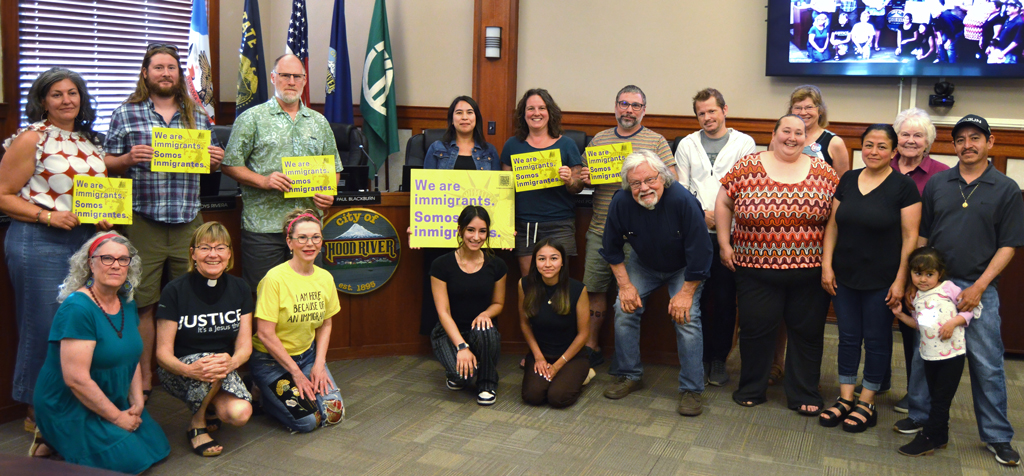
Discussions focusing on the impacts of ICE and federal immigration enforcement on the community have continued to be a focus at Hood River City Council meetings. At their January 12 regular meeting, City Council ratified the Declaration of a State of Emergency issued by City Manager Abigail Elder on December 12, and passed Resolution 2026-02 Declaring the City of Hood River a Sanctuary City for All Persons, Regardless of Race, National Origin, Immigration or Refugee Status. Community members filled City Hall to share stories of community members living in fear of immigration enforcement, voice support for becoming a Sanctuary City, and urging Council to do all in their power to protect the immigrant community.
In addition to the Resolution and Emergency Declaration, Elder provided an update on additional actions previously requested by council, which include training for staff, listening sessions, and a town hall. Council also adopted a new staff policy on how to respond to immigration enforcement requests or interactions, and hopes to better understand the needs of impacted community members through the listening sessions and town hall before determining further actions.
Many council members, as well as members of the public, expressed frustration that a resolution does not give the City the authority or power to stop federal immigration enforcement in the area. “One of the really frustrating things about this, is that there are a lot of things that we would like to do, that I don’t think we can do… and we have an administration doing things that are not legal, and we’re trying to follow the law and do the right thing,” said City Councilor Ben Mitchell.
Council acknowledged the potential risk of losing federal grants or drawing the attention of the administration but felt that the community’s desire for a Sanctuary City Resolution outweighed any economic or political concerns. “The idea that protecting our immigrant community risks our economy ignores the fact that Latinos are our economy,” Council President Gladys Rivera stated. “And even if there was no economic input argument, the answer would still be the same… Immigrants, they are people.”
Despite the Resolution’s limitations and potential risks, Council members expressed a desire to keep researching additional ways to respond to and from residents most impacted by current escalations in immigration enforcement.